
Before Game 3 of the 2025 Eastern Conference Finals, former Knicks head coach Tom Thibodeau made a change that many had been clamoring for for months: Mitchell Robinson joined the starting lineup in place of Josh Hart. This was a desperation move. After falling behind 2–0 (both losses at Madison Square Garden), the Knicks were looking for a spark. And though they surprised Indiana in Game 3, the damage had already been done and the Knicks fell in six games.
The Knicks’ 2024–2025 campaign, filled with ups and downs, was many things, but perhaps more than anything else, rigidity is what defined it. Thibodeau trotted out the starting lineup of Jalen Brunson–Josh Hart–Mikal Bridges–OG Anunoby–Karl-Anthony Towns for a grand total of 1,898 non-garbage-time possessions, by far the most in the NBA, and they outscored opponents by 4.1 points per 100 possessions (51st percentile in the NBA).
To many, Thibodeau’s dismissal signaled a desire to raise the ceiling—an indication that change was on the horizon. Mike Brown was going to come in and be more collaborative with the front office. By all reports, he has been.
Yet less than a year later, the Knicks are in a shockingly similar spot. In 813 possessions, the Knicks’ starting lineup has actually been worse, outscoring opponents by 3.7 points per 100 possessions (52nd percentile). And Brown does not have the leeway his predecessor did. Brown has almost 2,000 possessions worth of evidence that Thibodeau didn’t, a (sort of) healthy Mitchell Robinson, and a Miles McBride with a more established track record.
Brown could have gone in any direction. The Knicks’ floor is almost impossibly high. There was no real risk (barring significant injuries) of missing the playoffs or even falling into the play-in. Even with confidence that improved tactics could make the current starting lineup better, there was ample opportunity to experiment with a variety of lineups and strategies.
But here we are, barely a month from the start of the playoffs, and the Knicks’ problems largely mirror those from last season. How did they get here? And what’s the fix?
Let’s dive in.
Why Doesn’t the Starting Lineup Work?
It’s a reasonable question.
This is a lineup with five players ranging from good to All-NBA. It seemingly has everything. Jalen Brunson and Karl-Anthony Towns are all-world offensive players who are theoretically synergistic. Mikal Bridges, Josh Hart, and OG Anunoby (nicknamed “Wingstop” early last season) are supporting pieces that should be additive next to Brunson and Towns while helping to insulate their weaknesses defensively.
Make a checklist of the skills and qualities you want in a lineup, and these five players unquestionably check a lot of boxes.
Inspect a bit closer, however, and cracks in the armor begin to form. This lineup puts a lot of pressure on Brunson to initiate offense and arguably just as much on Towns (with assistance from Hart) to protect the defensive glass. And while the members of Wingstop are all very good defenders—Hart is quietly enjoying his best defensive season this year—Towns is hardly the ideal candidate as the last line of defense on the back line should any of them get beaten at the point of attack. Making matters worse, screen navigation just so happens to be a relative weakness for all three, particularly Bridges.
And then there’s the giant elephant that appeared last January.
After a blazing start that saw this lineup dismantling opponents largely on the back of Brunson and Towns two-man actions, opponents slowly started to realize they could neutralize that action by deploying ghost coverage—a defensive strategy where a team cross-matches its rim protector onto Hart and switches a wing onto Towns, willingly living with open Hart three-pointers if it makes life harder on the other four players.
The Knicks have built-in counters. Specifically, they’ve tried using Hart both as the primary screener for Brunson and off-ball, setting pindowns and flares. They’ve even let him initiate offense occasionally—anything to punish his defender for sagging off him.
The problem is that this is an active trade-off.
If you acquire Towns to play center, the goal (presumably) is to maximize his offensive impact. His greatest gift is his shooting and the gravity that comes with it. By merely accepting ghost coverage and trying to work around it, the Knicks are accepting a world where Towns is a lesser version of himself.
Making matters worse, not all opponents utilize this strategy. Many teams aren’t even capable of executing it. And when the Knicks face a traditional defense—one that sees a center guarding Towns and a wing on Hart—they’ve been drastically better. Per Shax on Twitter, as of their recent victory over the Spurs, the Knicks score 1.17 points per possession (PPP) when a center guards Towns (54% of the time, 273 possessions) compared to just 0.83 PPP when a center guards Hart (31% of the time, 155 possessions).
Add all of this up and you get a lineup that has a +20.7 net rating and 119.0 offensive rating against bottom-10 teams, while posting just a -5.7 net rating and 108.2 ORTG against top-10 teams—a fall-off as decisive as it has been consistent.
One thing that often gets lost in all of this: it’s not just Towns and, to a lesser degree, Brunson who are hurt by this dynamic. Hart’s overall impact is suppressed as well. Placing him in lineups where he is the sole non-shooter unintentionally amplifies his weaknesses. Hart is a great player who very easily could be a contributor on a championship contender. But he, like 99% of players in the NBA, needs to be placed in ideal conditions to give him the best chance to succeed.
What’s the Solution?
Unfortunately, at this point, there are no guaranteed fixes.
As mentioned above, the Knicks had two seasons to create meaningful sample sizes for all of their options and have failed to do so. Whether that is due to locker-room politics or coaching/front-office preferences, we may never know. What we do know is that there are three reasonable starting lineup options, and the current lineup has played almost seven times more minutes than the other two combined.
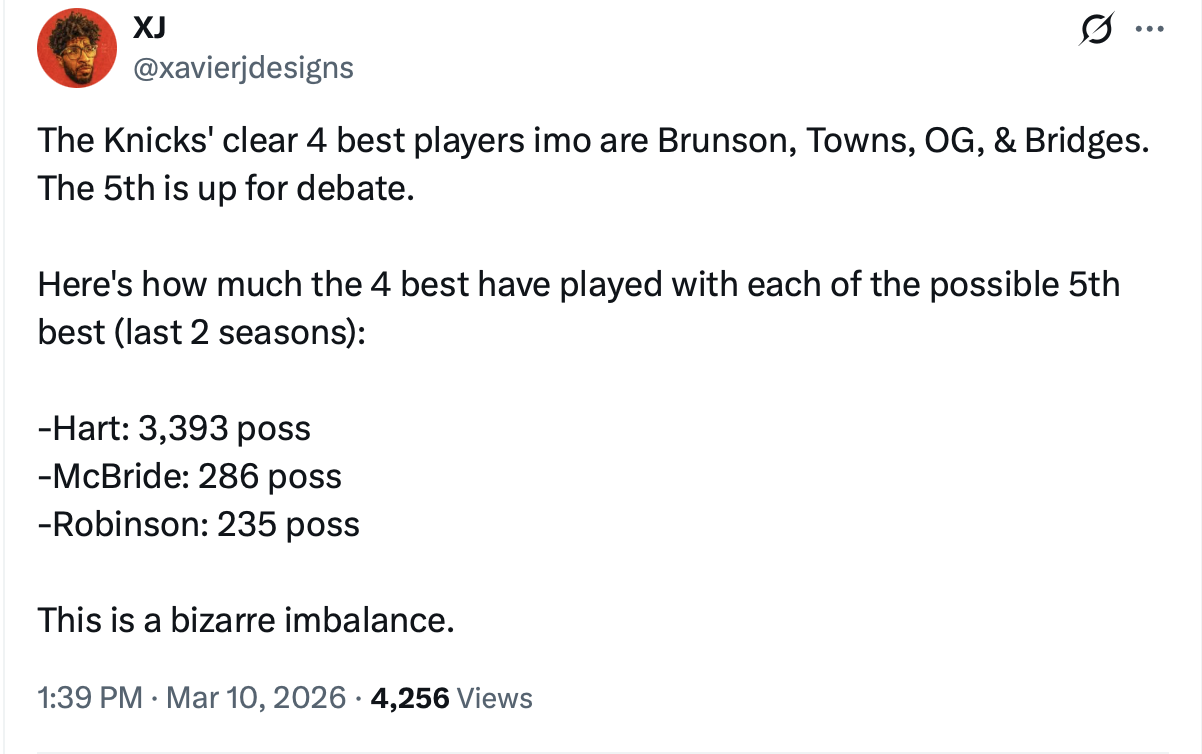
A tantalizing aspect of the Knicks’ roster is its versatility. That these three lineup options offer such stark potential strengths is emblematic of that.
A lineup with McBride in place of Hart maximizes spacing without hurting the team’s defense. McBride addresses the two biggest issues with the starting lineup: smart opposing defenses can no longer ghost as effectively, and McBride also happens to be the team’s best point-of-attack defender.
There are fair skepticisms about this lineup. The Knicks’ main four are already fairly small. Would replacing Hart—someone who plays much bigger than his 6'4 frame—with another small guard next to Brunson allow opponents to bully the Knicks in the paint? Would a coach like Joe Mazzulla simply stick with a version of ghost coverage and pivot to daring OG Anunoby or Mikal Bridges to beat him?
One critique I haven’t seen: what if Jalen Brunson simply isn’t built to maximally leverage five-out spacing? Brunson is the king of craft. He seems to thrive in a phone booth and loves creating contact. Is there a world where he simply doesn’t have that Tyrese Haliburton-style approach—anticipating early rotations and whipping skip passes ahead of the help?
To be clear, the validity of these critiques is up for debate, but they do not justify negligence.
McBride might simply be better than Hart.
The two best top-down impact metrics—DunksAndThrees’ EPM and BBallIndex’s LEBRON—rate McBride meaningfully higher. Over the past two seasons, the Knicks have been 6.3 points per 100 possessions better when McBride plays than when he sits, while they’ve been 3.9 points per 100 worse when Hart plays versus when he sits. That’s more than a 10-point difference between the two. The Knicks passed on experimenting with this lineup, and now—with McBride likely out until the playoffs—it may be too late.
Which brings us to door number two: Mitchell Robinson.
In the summer of 2014, there were rumors of a potential Kevin Love–for–Klay Thompson swap. The Warriors reportedly passed on the deal due to concerns about building a championship-level defense around Steph Curry and Kevin Love.
In hindsight, it appears they made the correct decision in holding onto Thompson.
The Knicks may have similar fears about Brunson and Towns. And while Robinson isn’t a spacer, his elite offensive rebounding ability prevents opposing defenses from stashing a wing on him and loading up on the other four offensive players. He demands attention in a similar way that an elite spacer does—just a different kind of attention.
Robinson opens up tactical doors.
He allows Towns to screen for Brunson while Robinson waits in the dunker spot. The Knicks can run double-drags. And Robinson provides a level of rim protection that no one else on the roster can match. Just as importantly, his presence allows Towns to avoid playing drop coverage and lean into his best defensive skill: his switchability.
The Knicks have worked tirelessly to keep Robinson healthy for the playoffs. One might argue that Robinson not playing back-to-backs is what has kept him out of the starting lineup. While some might see this as a chance to kill two birds with one stone—starting Robinson when he plays and trying another option when he doesn’t—there is value in consistency. Who knows what such chaotic role transformations might do to the players or the team’s chemistry?
In the end, that may be the biggest issue with the status quo: we don’t know much of anything. We don’t know how Brunson or Towns would be affected by having more space, or how that would compare to what they lose in other areas. Maybe going big is the answer. That lineup has played just 50 non-garbage-time minutes this season.
What we do know is this: One lineup has played an inordinate percentage of the team’s minutes across two seasons. The overall results have been underwhelming. The results against teams that deploy ghost coverage have been dire. And unless certain tactical changes—or improvements—happen first, that may be what ultimately dooms this team for the second straight season.
